


Xiaomi Home
Beijing Xiaomi Mobile Software Co.,Ltd
I use Xiaomi Home as the central place for managing Xiaomi smart-home products, and my overall impression is that it works best when your home already contains several devices from the same ecosystem. Instead of jumping between separate controls, I can open one app and look for the products connected to my Xiaomi setup. That simple idea is the app’s biggest strength, but it also explains its main limitation: the experience becomes much less useful if most of your devices come from other brands.
This is a free lifestyle app from Beijing Xiaomi Mobile Software Co.,Ltd, designed for Android users who want one control point for Xiaomi Home equipment. It has reached over 50 million installs and holds a 4.5 average from around 1.6 million ratings, which gives a good indication that it is widely used rather than being a niche companion tool. I would recommend trying it if you are building a Xiaomi-centered smart home, but I would not install it simply because you own one unrelated connected product.
How the current Xiaomi Home experience feels
The first thing I notice is the app’s role as a household dashboard. Its value is not in one spectacular feature; it comes from bringing compatible Xiaomi devices into a familiar mobile interface. Once the right products are connected, the app becomes the place I return to for checking their status, opening controls, and adjusting settings that would otherwise be scattered across individual accessories.
That makes it particularly practical for routines that happen repeatedly. I can imagine using it before leaving home to check connected equipment, opening it when I want to adjust a device without searching for a physical control, or using it as a shared reference point for family members who do not want to learn several different companion apps. The benefit is strongest when the household has enough Xiaomi equipment for centralization to matter.
The interface is approachable for ordinary users, but a smart-home hub is never completely effortless. The quality of the experience depends on the device being added, the account setup, the network connection, and regional compatibility. Xiaomi’s product range is broad, so two users can have noticeably different experiences even while using the same app. One person may see a clean collection of useful controls, while another may spend more time dealing with device discovery or settings that vary by product.
Latest News

Uber Eats Under Pressure: What Happens When Delivery Goes Wrong

How QR & Barcode Scanner Adapts to Android and iOS Innovations

Why Waze Navigation & Live Traffic Is Your Essential Travel Companion

CapCut Mastery: Unleash Hidden Features for Pro-Level Editing

How OS Updates Enhance Roblox Adventures

Teacher Simulator: Exam Time Turns Quick Classroom Judgments into a Repetitive Loop
I also appreciate that the app is aimed at a general audience. Its content rating is Everyone, and the basic concept does not require specialist knowledge. You do not need to understand networking to begin exploring it. However, beginners should still expect to spend a little time naming devices clearly and organizing the home view. That small effort pays off later, especially when several products have similar names or are installed in different rooms.
What the version information tells me
The current Android release is version 11.4.702, while the app itself first appeared on February 28, 2016. That long history matters because Xiaomi Home is not a brand-new utility being tested in isolation; it is an established control layer that has had time to grow around Xiaomi’s expanding hardware ecosystem. I see the current version as part of an ongoing product rather than a one-off remote control.
Its minimum requirement is Android 7.0, which keeps the app available to people using older Android phones while still placing a boundary around very old devices. In practical terms, I would still make sure the phone has enough free storage, a stable connection, and a reasonably current system environment before blaming the app for setup trouble. Smart-home problems often come from the relationship between phone, router, account, and device rather than from one screen inside the application.
Gallery
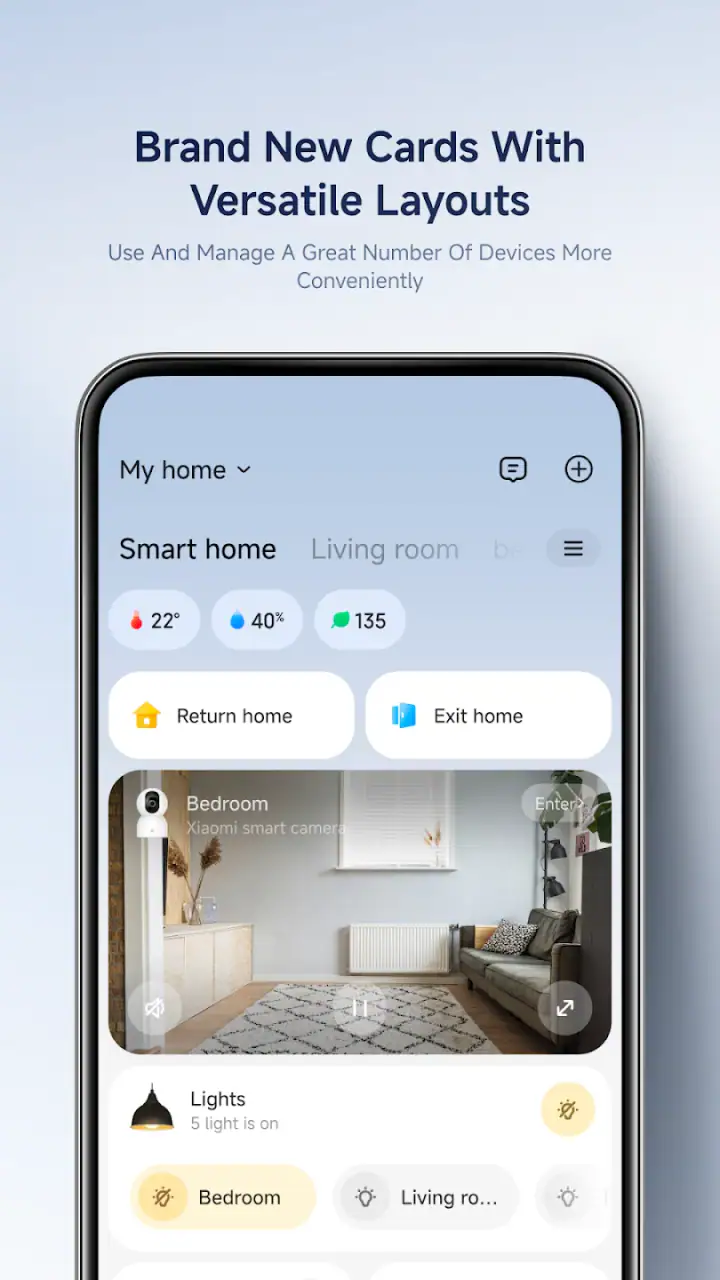
The app’s evolution is easiest to understand through that ecosystem role. As Xiaomi adds or refreshes hardware, the companion software has to remain a common doorway into different kinds of products. That creates convenience, but it also creates unevenness. A feature that feels polished for one device may be less central or less refined for another because the app is serving many product families at once.
A realistic evening at home
Consider a simple example. I arrive home with groceries, put my phone down, and want to check the Xiaomi devices around the apartment without walking from room to room. A single dashboard is more useful than opening separate apps for every product. I can use the central app as a quick overview, then enter the relevant device when I need more detailed control. That is the kind of small convenience that makes a connected home feel less fragmented.
The same workflow also exposes a trade-off. If the app lists many devices, the dashboard can become less immediate. Clear room names and descriptive device labels are more important than they first appear. I would name products by location and purpose rather than leaving default names in place. This is a modest organizational tip, but it reduces mistakes when I am in a hurry and makes the app easier for another person in the household to understand.
What works well and where the friction appears
The strongest reason to use it
The central advantage is consolidation. Xiaomi Home gives Xiaomi users a single place to think about their connected equipment instead of treating every product as a separate island. That is more valuable than it sounds because the annoyance of smart-home ownership often comes from remembering which app controls what. When the ecosystem matches, this application removes part of that mental overhead.
I also find the app more suitable for gradual adoption than a collection of isolated tools. Someone can begin with one Xiaomi product and later add others without immediately changing the overall control habit. The app is therefore a sensible foundation for users who expect their home setup to grow, provided they are comfortable remaining within Xiaomi’s product family.
Another useful insight is that the app should be treated as an organizer, not merely as a replacement remote. The best results come from deciding how the household will use it: which device names are obvious, which rooms need separate organization, and which controls should be easy to reach. A few minutes spent on that structure can make daily use feel much smoother than simply installing the app and accepting every default.
Where existing users may notice changes
For people who have used Xiaomi Home for years, a newer version can feel less like a completely new application and more like a continuing adjustment to a larger catalog of products. The current release number signals active maintenance, but I would avoid assuming that every update will transform the interface or solve every device-specific annoyance. Product evolution in an ecosystem app is often incremental: compatibility, organization, and small interaction details matter as much as visible redesigns.
Existing users should revisit their device organization after updates or after adding new hardware. A growing list can make the home screen harder to scan, and old names may no longer make sense once the household changes. I would also check the individual device pages rather than judging the whole app from the dashboard. The central view may be perfectly convenient while a particular product still requires more steps than expected.
There is a second practical trade-off for long-term users. Centralization is convenient, but it increases dependence on one account and one ecosystem. If most of your home is Xiaomi equipment, that dependence may be acceptable. If you deliberately mix brands, you may prefer a broader smart-home platform that treats several manufacturers more equally. Xiaomi Home is strongest when consistency matters more to you than universal coverage.
Who should choose it, and who should skip it
I think the app is a good match for Xiaomi device owners who want a unified household view, people starting a Xiaomi-focused smart home, and families that prefer one familiar Android application over several separate companions. It is also a reasonable choice for users who value convenience over endless customization and who are willing to organize their devices carefully.
I would be more cautious if you own only one Xiaomi product and do not expect to add more. In that situation, the dedicated control experience may already be enough, and a central hub may not add much. I would also look elsewhere if your priority is controlling a wide mix of brands from one neutral platform. Xiaomi Home can be the right tool for a Xiaomi household without being the best universal solution.
People who dislike account-based ecosystems or who want complete independence from a manufacturer should think carefully before committing. The app’s appeal comes from the relationship between Xiaomi hardware and Xiaomi software. That relationship is convenient, but it is also the boundary of the experience. A broader platform may be a better long-term choice if flexibility across manufacturers is more important than a consistent Xiaomi interface.
Small habits that improve daily use
My first recommendation is to name every device immediately after setup. Use a room and a purpose, not a vague product label. This becomes especially helpful when someone else in the home needs to find the right control without asking which identical-looking entry is which.
Second, keep the dashboard focused on the devices you actually check. A smart-home app can become cluttered when every connected item receives equal visual attention. I prefer a layout that makes common actions obvious and leaves occasional settings inside the relevant device page. That approach makes the app feel faster even when the number of products increases.
Third, test important actions before relying on them in a stressful moment. For example, if I expect to use the app while leaving home or arriving late, I would first confirm that the relevant product appears clearly and that I know where its main control lives. This is not glamorous advice, but it prevents the common mistake of discovering the app’s navigation only when I am already in a hurry.
Finally, I would separate an app problem from a device problem. If one product behaves differently, I would inspect that product’s own page and setup rather than assuming the entire Xiaomi Home experience is failing. The application is a shared shell for many devices, so troubleshooting becomes easier when I isolate the exact product and action involved.
Costs, expectations, and everyday suitability
The app is free to download, which makes experimenting with the Xiaomi ecosystem relatively easy. It does include in-app purchases ranging from $0.99 to $599.99 per item, so I would not confuse the free app with a promise that every connected-home experience is cost-free. The larger expense is usually the hardware ecosystem itself, and the app’s usefulness naturally depends on what equipment you connect to it.
That distinction is important for someone comparing it with ordinary lifestyle utilities. Xiaomi Home is not valuable because it replaces a calendar, notes app, or general home organizer. Its purpose is narrower and more practical: it gives Xiaomi-connected products a shared operating space. If you do not have compatible hardware, there is little reason to keep it installed simply for the brand name.
What I would like users to watch over time
When considering future updates, I would pay attention to how well the app handles a growing device collection, how clearly it separates room-level organization from individual product controls, and whether older Android phones continue to feel comfortable with the current release. Those are more meaningful indicators for daily use than a new visual detail on the opening screen.
I would also watch the balance between simplicity and depth. New users need a clean path to basic controls, while experienced owners want settings that do not feel buried. Xiaomi Home has to serve both groups, and that is a difficult design problem. If the app becomes too minimal, advanced users may feel restricted; if it becomes too crowded, beginners may struggle to find the action they need.
My final view is positive but specific. Xiaomi Home is most convincing as the control center for a Xiaomi-centered household, not as a universal answer for every smart-home arrangement. Its free entry point, broad adoption, accessible age rating, and continuing development make it easy to try. The real test is whether your devices fit its ecosystem and whether you are happy to invest a little time in organization.
After using it, I would recommend it to a friend who already owns several Xiaomi products or plans to build around them. I would not recommend installing it blindly for a mixed-brand home, because a broader platform may reduce long-term friction. For the right household, the app turns a collection of separate devices into something easier to manage. For the wrong one, it can simply become another manufacturer-specific app competing for space on the phone.
In short, Xiaomi Home succeeds through practical consolidation rather than flashy novelty. Beijing Xiaomi Mobile Software Co.,Ltd has built an established Android companion that keeps the Xiaomi ecosystem approachable, while its limitations come from that same ecosystem focus. If your priorities are clear, the decision is straightforward: choose it for coordinated Xiaomi control, and look beyond it when cross-brand freedom matters more.
FAQs for Xiaomi Home
What is Xiaomi Home and how does it work?
Xiaomi Home is a comprehensive smart home management app designed to control and monitor a variety of Xiaomi smart devices. It allows users to connect and manage their smart gadgets from a single platform, providing seamless integration with devices like smart lights, cameras, and thermostats. The app is compatible with both Android and iOS, making it accessible to a wide range of users.
Is Xiaomi Home compatible with non-Xiaomi devices?
While Xiaomi Home is primarily designed for Xiaomi devices, it also supports a range of third-party products compatible with the Mi ecosystem. However, compatibility can vary, so it's essential to check if your non-Xiaomi devices support integration with the app to ensure smooth functionality.
How secure is the Xiaomi Home app?
Xiaomi Home prioritizes user security by implementing robust encryption protocols to protect data transmission. The app regularly updates its security features to safeguard against vulnerabilities. However, users should enable two-factor authentication and keep their devices updated to enhance security further. Always download the app from official stores to avoid security risks.
Can I control my Xiaomi devices remotely with Xiaomi Home?
Yes, Xiaomi Home allows remote control of your connected devices. As long as your smartphone has an internet connection, you can manage and monitor your devices from anywhere. This feature is particularly useful for adjusting settings or checking on your home while you're away, offering convenience and peace of mind.
Does Xiaomi Home require a subscription or additional fees?
Xiaomi Home is free to download and use, with no mandatory subscription fees for basic functionalities. However, some advanced features or third-party device integrations might require in-app purchases or subscriptions. Users should review the app's offerings and any potential costs associated with specific functionalities before downloading.
Pros
- User-friendly interface for easy navigation.
- Seamless integration with Xiaomi devices.
- Customizable automation routines.
- Real-time device monitoring and alerts.
- Supports voice control with assistants.
Cons
- Limited compatibility with non-Xiaomi devices.
- Occasional connectivity issues.
- Some features require a Xiaomi account.
- In-app ads can be intrusive.
- Updates may introduce bugs.


